Animal cell coloring pages
Cells are the building blocks of life. Here we are looking at cells that make up the creatures in the animal kingdom. While most cells need a microscope to be observed, these animal cell coloring pages give us a wonderful up close view of their makeup. The printables provided here can be used to teach and reinforce animal cell vocabulary in fun and interesting ways.
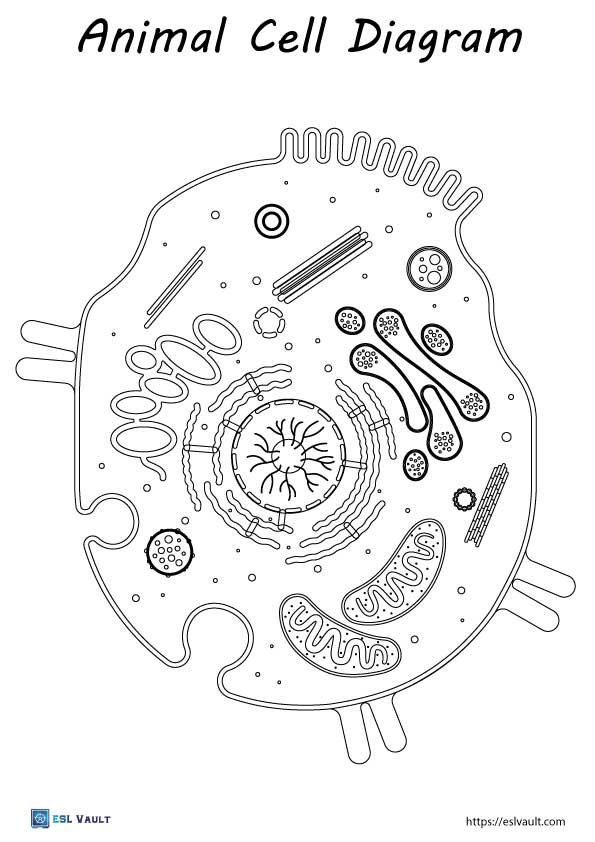
You will find blank animal cell diagrams that students can label themselves with a suitable amount of cell part names that you assign to be studied or reviewed. There are also labeled animal cell coloring sheets that can be used as answer keys or as easy introductory worksheets into the subject.
Looking for plant cells? Check out the plant cell diagram coloring pages.

A great way to use these cell pictures is to ask your class to color them according to their parts. This can either be dictated orally or written on the board. For example, you can instruct learners to color the nucleus light blue, the mitochondria yellow, the Golgi Apparatus purple, and so on.
Students who are only beginning to learn about cells will need a textbook or a labeled image to help with this. You can also provide one of the labeled coloring pages below instead.
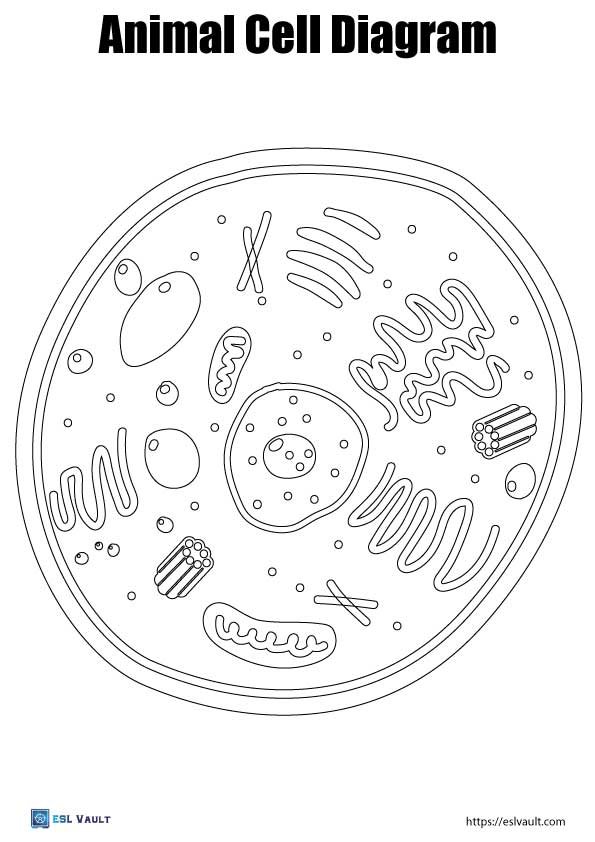

Another fun activity is to let students cut out the parts of the animal cells and recreate them on a separate sheet of paper. All they need to do is draw a cell/plasma membrane and place the pieces inside it appropriately. Note that if you plan on coloring the cell parts (organelles), it is best done before they are cut out.
The cell parts can also be stuck to an inflated balloon if you want to create 3D cell diagrams!

For a more advanced exercise, ask your class to write the functions of each of the cell parts that are being learned on the back of the coloring pages. This can be done as a research project or as homework. Encourage students to also add any interesting facts that they may come across.
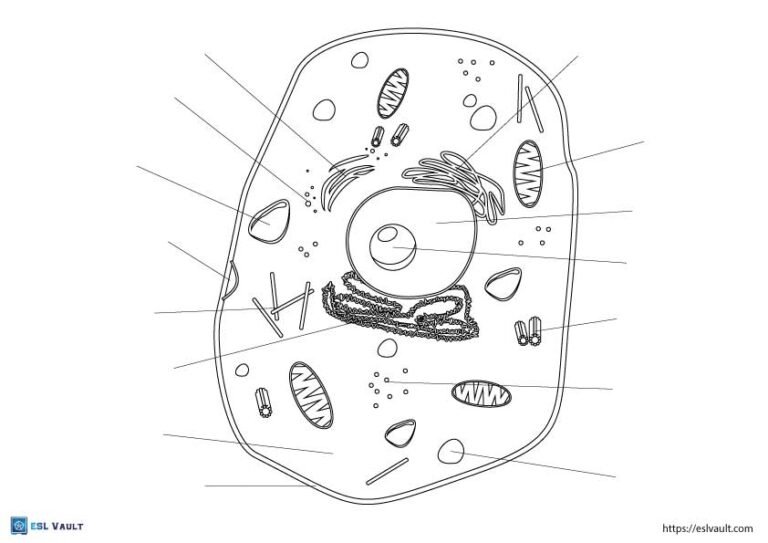

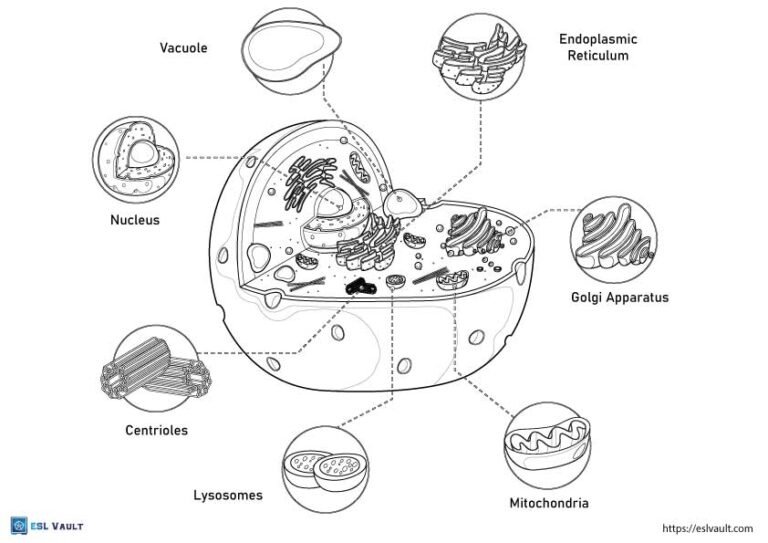

Parts of an animal cell
There are many different kinds of animal cells made up of various components. This is because they serve specialized functions. Some of these cell types include blood cells, fat cells, muscle cells, nerve cells, and skin cells.
The different parts that make up cells are known as organelles. Below are some of the organelles that you may want to add to your coloring pages along with a short definition/description of their functions.
Cell Membrane A thin outer layer that controls what enters and leaves the cell.
Centriole A small structure that helps organize microtubules during cell division.
Cilia Tiny hair-like structures that help move the cell or sweep materials across its surface.
Cytoplasm A jelly-like substance that fills the cell and supports the organelles.
Flagella A long, whip-like tail that helps some cells move.
Golgi Complex/Golgi Apparatus An organelle that sorts, packages, and transports proteins and other materials.
Lysosome A small sac filled with enzymes that breaks down waste and worn-out cell parts.
Microfilament A thin protein fiber that helps the cell keep its shape and move.
Microtubule A hollow protein tube that supports the cell and transports materials inside it.
Mitochondria Organelles that convert food into energy the cell can use.
Nucleoli Structures inside the nucleus where ribosome parts are made and assembled.
Nucleus The control center of the cell that stores the cell’s DNA.
Peroxisome An organelle that breaks down fatty acids and harmful substances.
Ribosome A tiny structure that builds proteins needed by the cell.
Rough Endoplasmic Reticulum A membrane network covered with ribosomes that helps make and transport proteins.
Secretory Vesicle A small membrane sac that carries materials to the cell membrane for release.
Smooth Endoplasmic Reticulum A membrane network that makes lipids and helps remove harmful substances.
Vacuole A storage sac that holds water, nutrients, and waste. Animal cell vacuoles are usually much smaller than those in plant cells.